

A Tokenized World: The New Normal
Why assets are moving onchain and what it means for global markets.


Moving Towards a World of Tokenization
We are entering a phase of the internet where everything that can be represented digitally will be represented digitally.
Just as information moved from paper to the web, ownership is moving from legal documents and siloed databases to programmable tokens.
This shift is not just cosmetic. It fundamentally changes who can access assets, how capital moves, and how value is created and distributed.
Tokenization is the mechanism enabling this transition.
At its core, tokenization is the process of representing ownership, rights, or exposure to an asset as a blockchain-native token. Once something becomes a token, it becomes programmable, composable, and globally transferable.
Asset tokenization involves representing the ownership rights of real-world and financial assets as digital tokens on a blockchain.
The Tokenization of Everything
Historically, ownership has been rigid. Assets were locked behind geography, regulation, minimum capital requirements, and intermediaries. Buying a house required lawyers and banks. Investing in private markets required accreditation.
Access to global markets depended on where you were born and which institutions would allow you in.
Tokenization removes many of these constraints by converting rights to a real-world or traditional asset into a digital token that can be traded, transferred, and programmed on a blockchain.
A token can represent full ownership, fractional ownership, or synthetic exposure. Fractionalization divides assets into smaller tradable units, allowing multiple holders to own a share of the same underlying asset.
This is why people talk about “tokenizing everything.” Not because everything should be speculative, but because tokenization turns static, traditionally illiquid assets into active, tradable financial primitives.
Digital tokens enable peer-to-peer transfer, faster settlement, and integration into decentralized financial systems.
Real-World Assets Go On-Chain
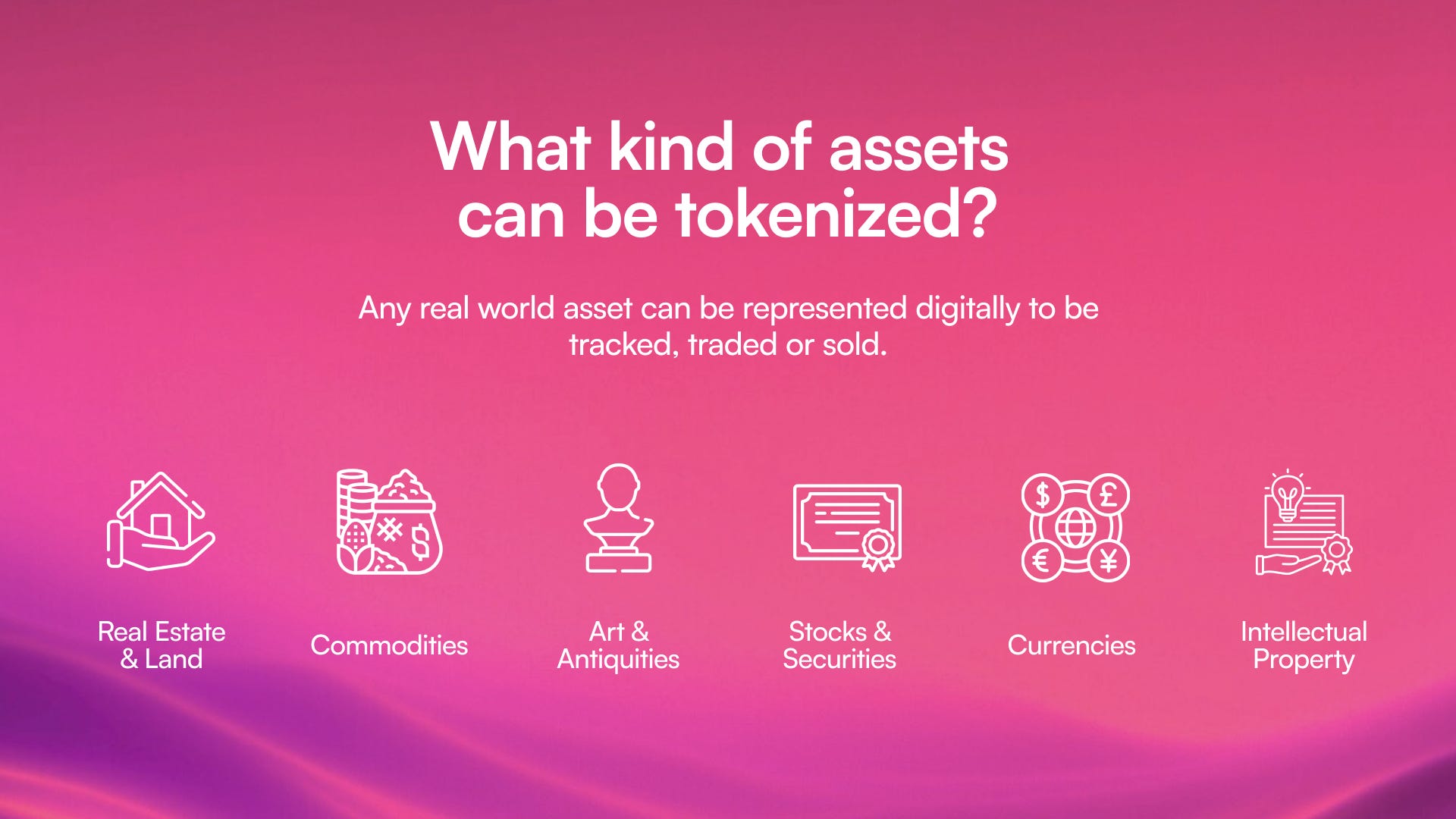
The most important evolution happening today is the tokenization of real-world assets (RWAs) — physical or financial assets that now have a representation on a blockchain. These include currencies, commodities, equities, bonds, and real estate.
→ https://chain.link/education-hub/real-world-assets-rwas-explained
Tokenization of RWAs broadens participation in markets that were once exclusive to institutional investors. Tokenizing real estate splits large properties into digital shares, enabling fractional ownership and lower capital entry requirements.
Once assets are tokenized, transactions often settle much faster than traditional markets and transparency increases because ownership records are immutably recorded on distributed ledgers.
Owning Anything, From Anywhere
In a tokenized world, the distinction between crypto assets and traditional assets begins to blur. Stocks, real estate, commodities, and even fine art can all be represented as tokens that trade on blockchain networks.
This unlocks a powerful idea: anyone with internet access and a digital wallet can gain exposure to global assets. Fractional tokenized ownership lowers capital barriers and enables broader diversification without traditional intermediaries.
Over time, this reshapes how people think about wealth. Instead of being limited to local opportunities or gated financial products, individuals can participate directly in global investment ecosystems. Tokenization expands economic inclusion by making assets more accessible and markets more efficient.
The Direction We Are Headed
Tokenization is not a trend. It is an infrastructural shift in finance. Just as APIs transformed software and exchange-traded funds (ETFs) transformed investing, tokenization is transforming ownership. We are moving toward a financial system where assets are open, composable, and globally accessible by default.
The real promise of tokenization is not just efficiency. It’s control. When anyone can own anything and portfolios can be automated, power shifts away from centralized institutions and back to individuals. People are no longer forced to rely on opaque funds, slow custodians, or restrictive financial products designed for the lowest common denominator.
This flexibility fundamentally changes the relationship people have with money. Ownership becomes global, programmable, and self-directed.
Tokenization is not just about putting assets on-chain. It is about restoring agency, giving people the tools to participate in markets on their own terms, and building a financial system that finally operates at the scale and openness of the internet.
 | A guest post by
|
Make Crypto Normal